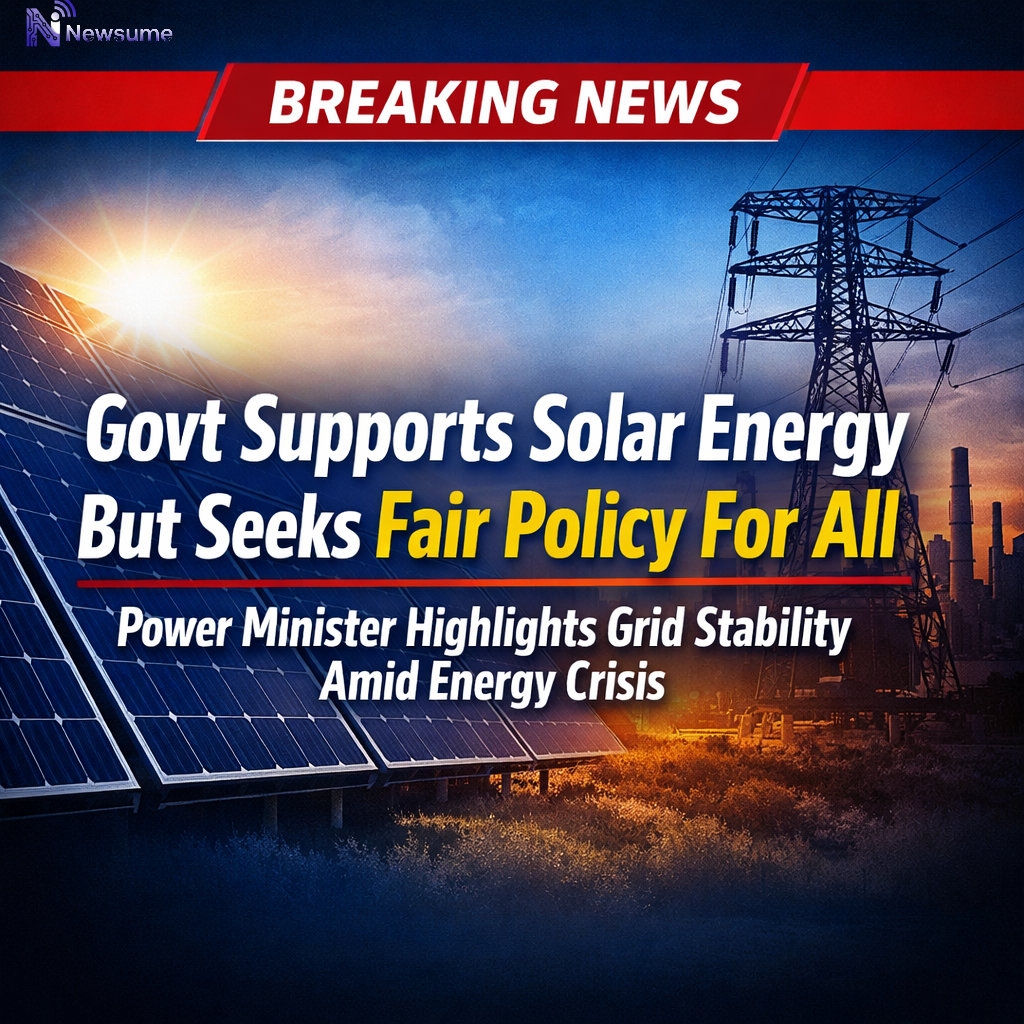
Pakistan’s government has reaffirmed its support for solar energy, while emphasizing the need for balanced policies that protect all consumers and maintain the stability of the national power system during ongoing global energy challenges.
Federal Minister for Power Sardar Awais Ahmed Khan Leghari clarified that the government is not opposed to solarisation. Instead, it aims to promote clean energy in a way that remains fair to both solar and non-solar users. He stressed that solar power contributes to electricity generation mainly during daylight hours, while reliable energy sources are still required at night to meet demand and ensure smooth grid operations.
The minister highlighted that a rapid increase in unmanaged rooftop solar installations can create technical challenges for the power grid. One key issue is the sharp rise in demand during evening hours when solar generation drops, increasing reliance on flexible power sources such as gas-based plants.
Leghari also pointed to the impact of global events on Pakistan’s energy supply, particularly disruptions in liquefied natural gas (LNG) due to the ongoing US–Israel–Iran conflict. In response, the government has introduced demand management measures across various sectors to maintain energy balance and avoid major disruptions.
He explained that Pakistan follows a balanced power generation strategy, where coal is used for base-load electricity due to its lower cost, while gas-based plants provide flexibility during peak demand periods. Eliminating gas-based generation entirely, he said, would negatively affect system reliability and responsiveness.
Addressing concerns about industrial energy use, the minister stated that recent data shows industries are largely continuing to rely on the national grid. Government initiatives, including a competitive electricity pricing package, have helped retain industrial demand and deliver significant cost savings.
Leghari further noted that Pakistan’s diversified energy mix has helped reduce the impact of global energy volatility. At the same time, the government is pursuing structural reforms, such as privatization of state-owned enterprises and opening the power sector to greater competition.
In conclusion, the government remains committed to expanding solar energy adoption while ensuring fairness, energy security, and grid stability. Authorities aim to balance clean energy growth with reliable power supply as Pakistan navigates a complex global energy environment.