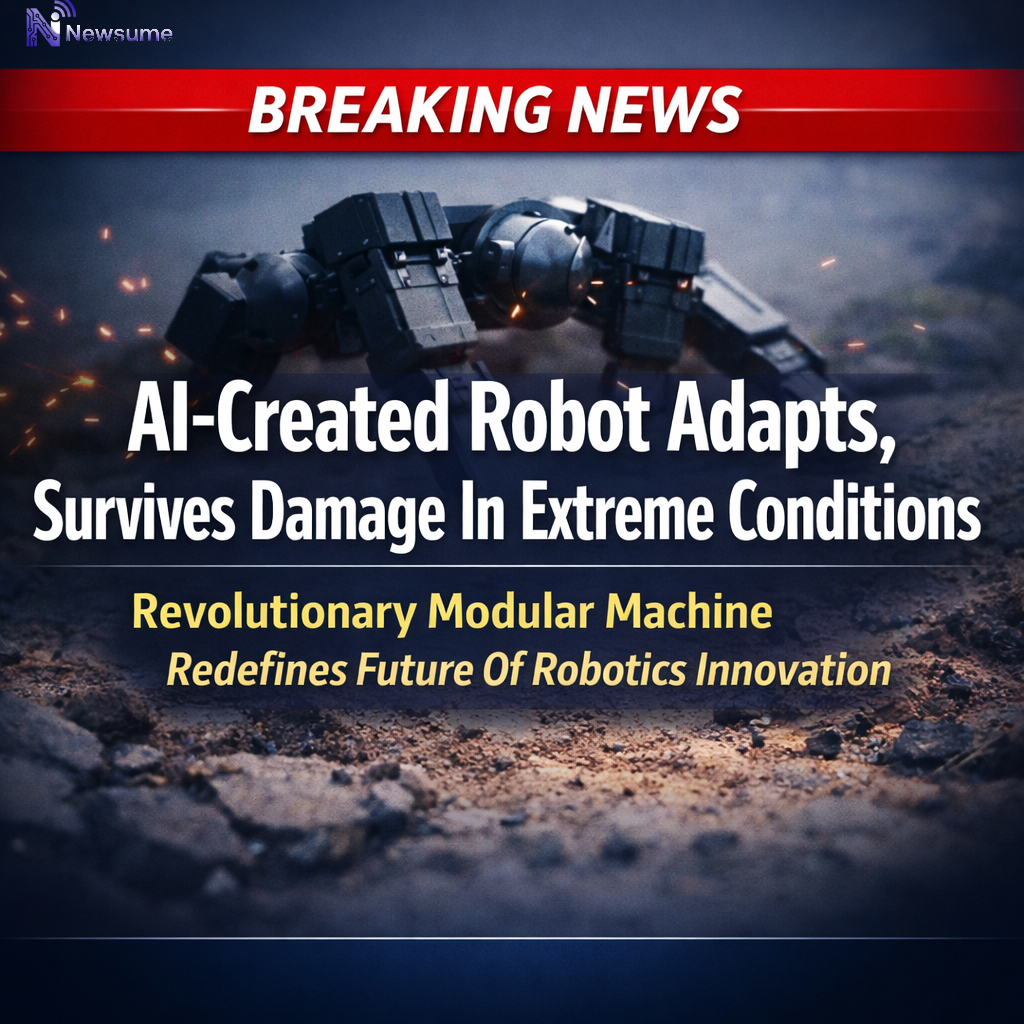
Researchers have developed a new type of robot using artificial intelligence that can adapt, reconfigure itself, and continue operating even after being damaged. The breakthrough highlights the growing role of AI in transforming robotics and engineering.
Traditionally, robots are designed for specific tasks and environments, such as factory floors or controlled indoor spaces. While efficient in those conditions, they often fail when exposed to unexpected challenges like rough terrain or physical damage. This limitation has driven scientists to explore more flexible and resilient robotic systems.
A team at Northwestern University has introduced a novel solution known as a “legged metamachine.” Instead of building a robot for a fixed purpose, the researchers created a modular system made up of small, independent units. Each unit contains its own motor, battery, and computing system, allowing it to function on its own or as part of a larger structure.
When combined, these modules can form different shapes and movement styles. The robot can crawl, roll, jump, or twist depending on the situation, enabling it to navigate complex and unpredictable environments. Even if one or more parts are damaged or detached, the remaining modules can reorganize and continue moving toward their goal.
What makes this development unique is the way the robot was designed. Instead of engineers manually creating the structure, the team used AI-based evolutionary algorithms. The system was given simple building blocks and a goal—to move efficiently. It then generated thousands of possible designs in a simulated environment, testing each one under various conditions.
Over multiple iterations, the AI selected the most effective designs and discarded weaker ones, similar to natural selection. This process resulted in innovative configurations that humans might not have imagined. The final designs were then physically built and tested in real-world conditions.
During outdoor experiments, the robot successfully moved across challenging surfaces such as grass, mud, and gravel. Unlike conventional robots, which often stop working after losing a part, this modular system continued functioning even after losing a limb or being split into pieces.
Despite its impressive adaptability, the technology is still in its early stages. The current version lacks advanced sensors, meaning it cannot fully perceive its surroundings or make complex decisions based on external inputs. Its movements are also relatively slow and unrefined, limiting its immediate practical use.
However, experts believe the project represents a major shift in robotics design. By using AI to evolve machines rather than manually design them, engineers can unlock new possibilities for building more resilient and intelligent systems.
In conclusion, this AI-developed modular robot demonstrates a significant step forward in robotics innovation. While not yet ready for widespread application, it introduces a new approach focused on adaptability and survival, potentially shaping the future of intelligent machines.