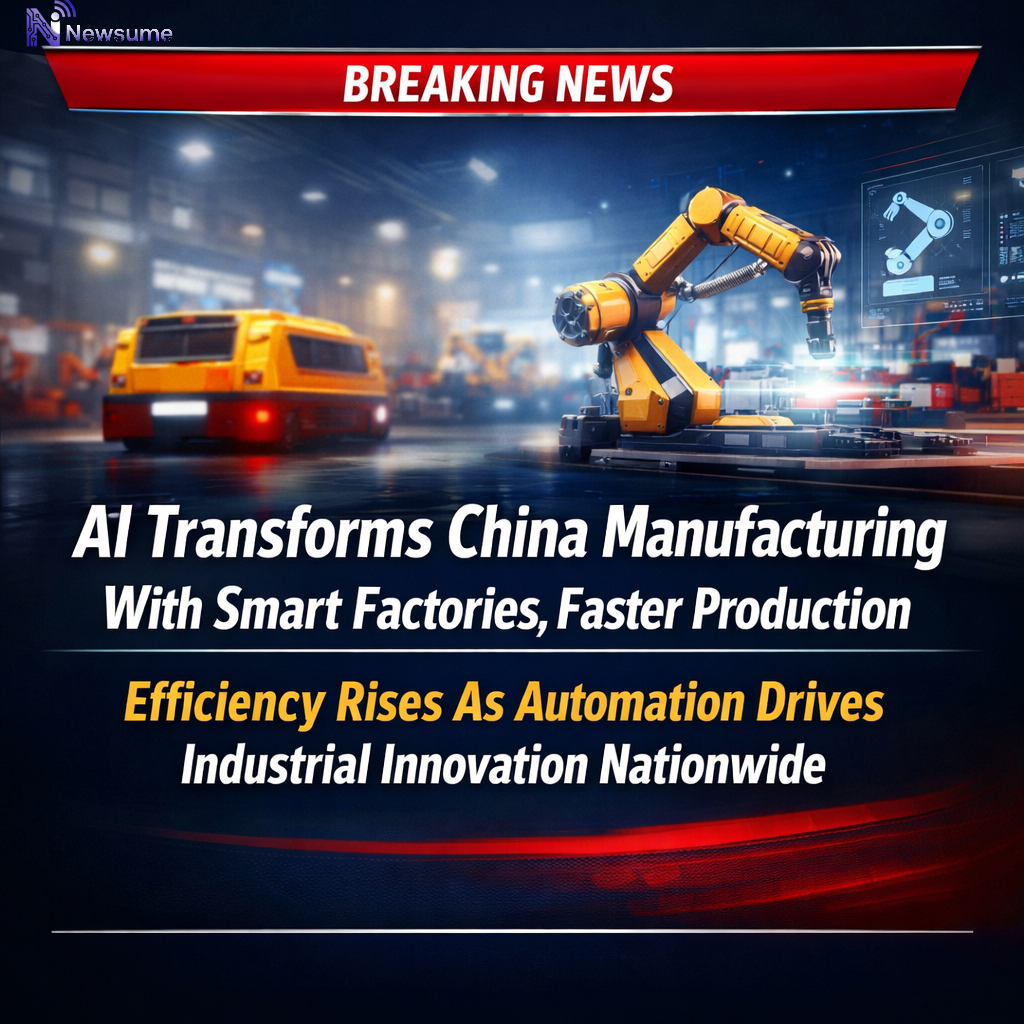
Artificial intelligence (AI) is rapidly transforming China’s manufacturing sector, improving production speed, reducing costs, and reshaping how factories operate. From product design to real-time production management, AI is becoming a key driver of industrial growth across the country.
In Hangzhou, a major technology hub in Zhejiang province, companies are already seeing the impact of AI. At Zhongce Rubber Group, engineers use intelligent systems to run up to 300 durability tests per second in virtual environments. This allows manufacturers to complete processes in days that previously took months, significantly accelerating product development.
According to company officials, AI-powered “virtual factories” help identify the best production solutions before physical manufacturing begins. This shift is transforming traditional workflows, making them faster, more precise, and data-driven.
Other manufacturers are adopting advanced automation systems as well. Hangzhou Robam Appliances operates a so-called “dark factory,” where production continues with minimal human involvement. Automated guided vehicles and smart platforms manage tasks such as inventory tracking, order processing, and production scheduling in real time.
The results have been significant. The company reports a 48 percent reduction in product development time, a 45 percent increase in efficiency, and a 21 percent drop in production costs. Industry experts say this reflects a broader trend, where AI is reshaping the entire manufacturing value chain, including research, production, and management.
Across China, AI is replacing traditional experience-based decision-making with data-driven processes. Advanced systems can analyze large datasets quickly to optimize product design and resource allocation. This has also improved coordination across departments, enabling faster order completion and delivery.
The Chinese government is actively supporting this transformation. Policies promoting “AI plus manufacturing” have led to the development of a large network of smart factories. By 2025, China had established over 35,000 basic-level smart factories, along with thousands of advanced and high-performance facilities.
Regional governments are also pushing innovation. Shanghai has launched a three-year plan to expand AI integration in manufacturing, while Hebei province is introducing AI applications across multiple industries. These initiatives align with China’s 15th Five-Year Plan (2026–2030), which emphasizes combining technological innovation with industrial growth.
Despite rapid progress, experts warn that challenges remain. AI systems must achieve high levels of accuracy and reliability to avoid risks in complex manufacturing environments. There are also concerns about high implementation costs, especially for small and medium-sized businesses, as well as the need for skilled professionals who understand both AI and manufacturing.
In conclusion, AI is playing a crucial role in modernizing China’s manufacturing sector, making it more efficient, competitive, and innovative. While challenges persist, the continued integration of AI into industrial processes is expected to drive long-term growth and reshape global manufacturing standards.