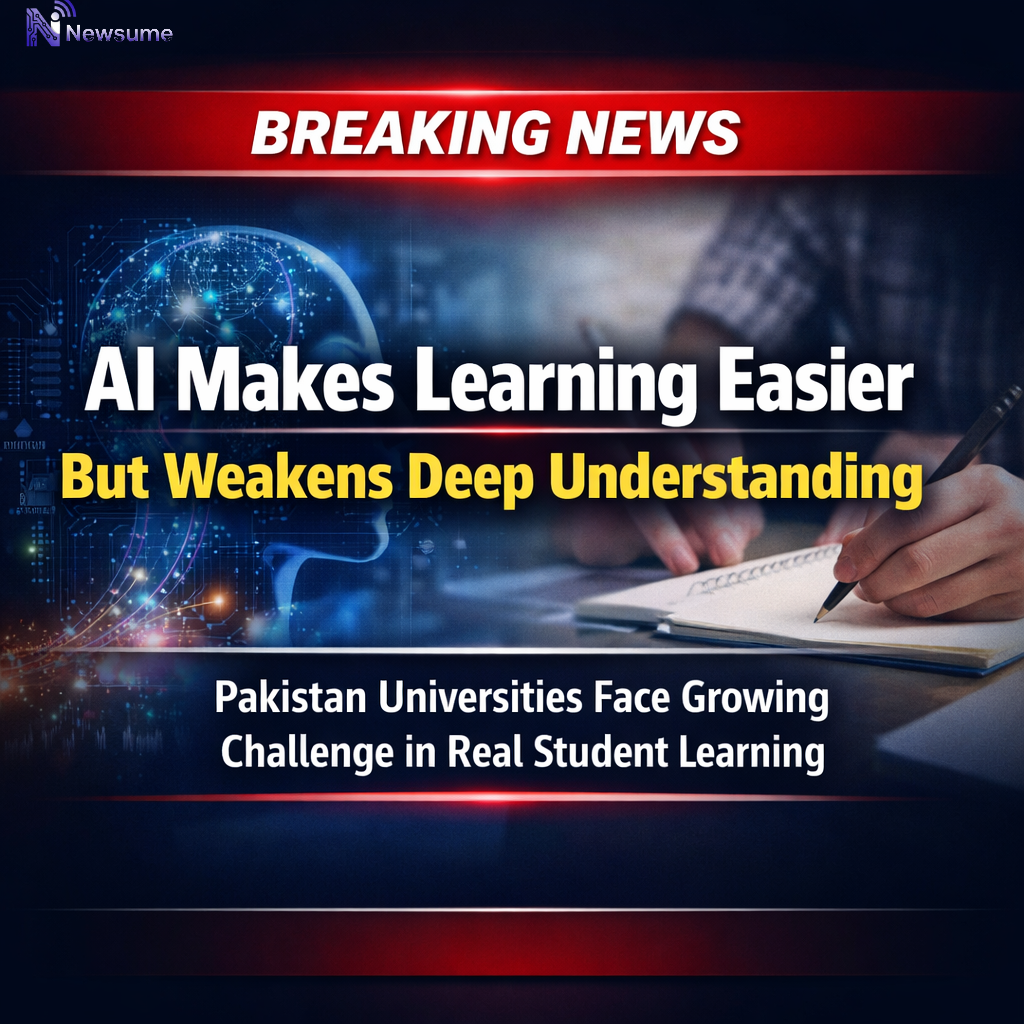
Artificial intelligence is rapidly transforming education, making information more accessible than ever before. However, experts warn that this ease of access may be creating an illusion of learning, especially in universities across Pakistan, where polished results are often valued more than true understanding.
In many academic institutions, students are producing well-structured assignments, presentations, and exam answers that appear impressive on the surface. Yet, this raises a critical concern: how much real learning is actually taking place? Over time, the focus of education has shifted toward final outcomes such as grades and completed work, rather than the mental effort required to understand concepts deeply.
Even before the rise of AI tools, this trend was already developing. The increasing emphasis on performance over comprehension has blurred the line between knowing an answer and truly understanding it. With AI now providing instant explanations, summaries, and ready-made responses, this gap is becoming even wider.
Artificial intelligence is not just a tool but a new learning environment. It delivers quick and clear answers, which can make users feel they understand a topic when they have only been exposed to it briefly. True learning, however, involves a deeper internal process, where information is processed, retained, and applied over time.
Experts highlight that real understanding requires focus and sustained attention—both of which are becoming harder to maintain in a world filled with constant information. When attention is limited, even easy access to knowledge does not lead to meaningful learning. Instead, students may confuse familiarity with actual knowledge.
Learning also involves struggle and mental effort. When students face difficulty, confusion, or frustration, it often signals that their thinking is evolving. This process helps build strong cognitive skills. However, when AI removes this challenge by offering instant solutions, it can reduce opportunities for deep thinking and intellectual growth.
Emotional engagement is another key factor in learning. Students need curiosity, interest, or motivation to fully absorb and retain knowledge. Without this connection, even difficult tasks may not lead to improvement. The concern is that AI-driven convenience may reduce both cognitive effort and emotional involvement in the learning process.
Experts suggest that the solution is not to ban AI but to use it wisely. Educational systems need to be redesigned so that students still engage in thinking, problem-solving, and reflection. Teachers can use AI as a support tool to create better learning experiences, encouraging students to attempt answers, revise ideas, and develop understanding step by step.
At the same time, institutions must rethink their assessment systems. When grades reward only completion and polished work, students naturally focus on producing results rather than learning. In the age of AI, this gap between performance and understanding is becoming more visible.
For Pakistan, this issue is especially important. With a large young population, universities play a key role in shaping future skills and knowledge. The challenge is not whether AI can produce better answers, but whether students can develop critical thinking and real understanding.
In conclusion, artificial intelligence presents both opportunities and risks for education. While it can enhance learning, it may also encourage superficial understanding if not used carefully. The future of education in Pakistan depends on finding the right balance between technology and meaningful learning.