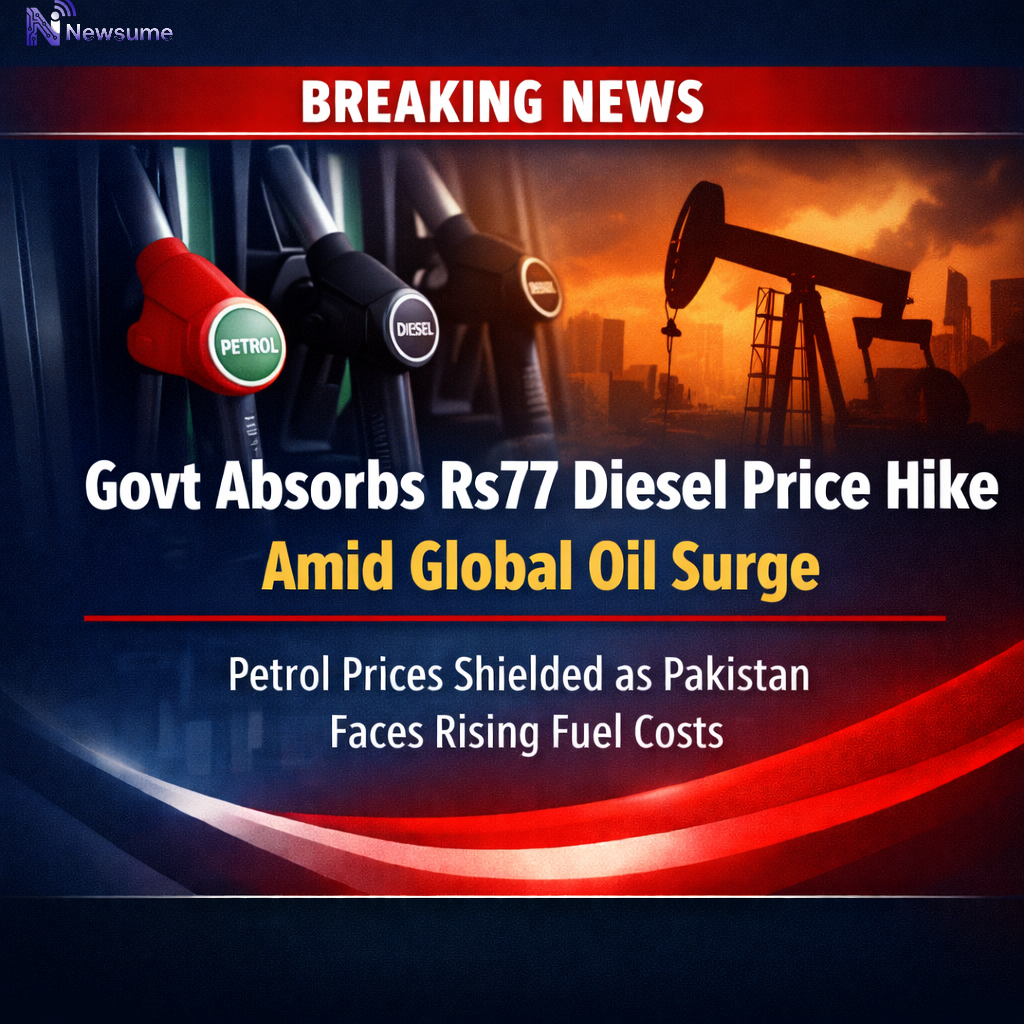
Pakistan’s government has reportedly absorbed a significant increase in international fuel prices in an effort to prevent a sharp rise in petrol and diesel rates for consumers. Officials say the state has not passed on the full impact of global oil price increases, shielding the public from higher fuel costs.
According to officials in Islamabad, international prices for petroleum products have surged in recent weeks. However, the government chose not to fully reflect these increases in local retail prices. Industry estimates suggest that around Rs77 per litre in high-speed diesel prices and nearly Rs48 per litre in petrol costs were not transferred to consumers in the latest price announcement.
Despite this move, authorities have not yet clarified how the financial gap will be managed. It remains uncertain whether the government will reduce the petroleum levy or introduce a reimbursement mechanism for oil marketing companies (OMCs) and refineries. Without a clear policy decision, the financial burden may fall on companies involved in Pakistan’s fuel supply chain.
Oil marketing companies import petroleum products based on international benchmarks and must cover additional costs such as freight charges, insurance, premiums and currency exchange fluctuations. Industry representatives warn that expecting companies to sell fuel at regulated prices while buying at higher global rates may create financial strain and could eventually disrupt supply stability.
Public debate over fuel pricing has intensified on social media, where many users compare local petrol prices with global crude benchmarks such as Brent crude. However, industry experts say these comparisons are misleading because Pakistan’s crude purchases are primarily linked to the Dubai benchmark rather than Brent.
Moreover, domestic petrol and diesel prices in Pakistan are not determined directly by crude oil prices alone. Under the country’s regulated pricing system, fuel prices are calculated based on international benchmarks for refined petroleum products, mainly derived from the Platts index. These benchmarks reflect the average price of refined fuel during a specific period, which then forms the base for domestic pricing.
Experts emphasize that focusing only on crude oil prices does not provide a complete picture of how fuel prices are set in Pakistan. Retail prices depend more on refined product costs, logistics, and exchange rate movements rather than crude benchmarks alone.
Some critics also argue that oil marketing companies benefit from inventory gains when prices rise. Industry players respond that inventory gains and losses are a normal part of the pricing mechanism. Companies may profit temporarily when prices increase, but they also face losses when prices decline, balancing out over time.
Pakistan’s petroleum market is also heavily influenced by state-owned companies. Pakistan State Oil (PSO) remains the country’s largest oil marketing company, while Pak-Arab Refinery Company is one of the major refiners. Together, these government-linked entities control a large share of the market, making claims of excessive private-sector profits less straightforward.
Beyond fuel prices, the petroleum sector is facing broader policy challenges. Fuel dealers have been waiting for a revision in their profit margins for over a year, while OMCs are also awaiting adjustments in regulated margins. At the same time, the Brownfield Refining Policy approved in 2023 has yet to be fully implemented, leaving investors uncertain about the future of the refining sector.
Overall, Pakistan’s fuel supply system depends heavily on imported petroleum, stable inventory management and clear pricing policies. Industry experts warn that confusion about the pricing structure and policy delays could create uncertainty in the market and place additional pressure on the country’s energy supply chain.