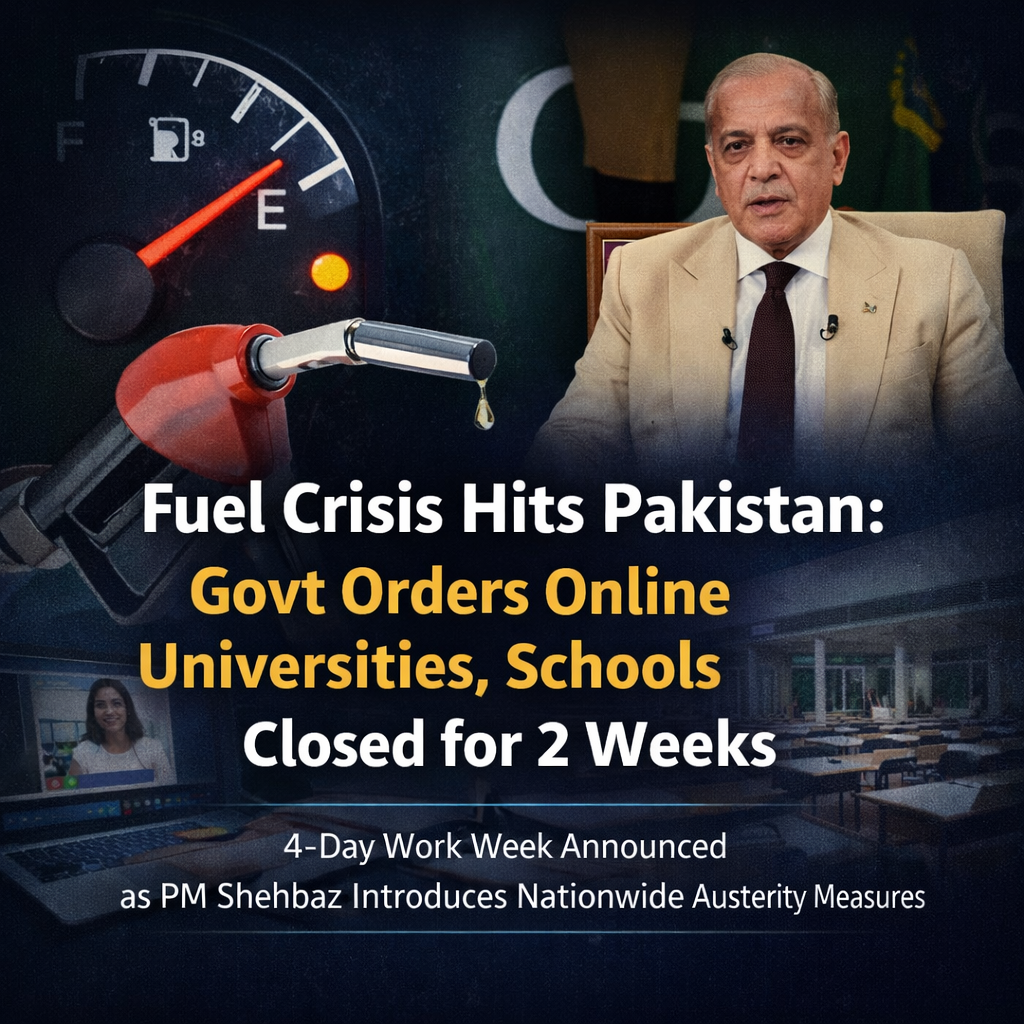
Pakistan has introduced sweeping austerity steps as the government responds to a sharp global fuel crisis caused by the escalating conflict in the Middle East. In a televised address, Prime Minister Shehbaz Sharif announced several emergency measures aimed at reducing fuel consumption, cutting government spending, and stabilizing the economy.
One of the major decisions is the temporary shift of higher education to online learning. Universities and other higher educational institutions across the country will conduct virtual classes from March 16 to March 31. At the same time, all schools will remain closed for two weeks during the same period. The government says the move is intended to reduce transportation and energy use nationwide.
Public sector offices will also operate under new restrictions. Government departments will adopt a four-day work week, while around half of the workforce will work remotely. Essential services, including healthcare and banking, will continue normal operations to avoid disruption.
The austerity plan also targets government spending. Fuel allowances for official vehicles will be reduced by 50 percent for the next two months, and 60 percent of government vehicles will remain off the road during this period. Emergency and public transport vehicles are exempt from the restrictions.
Senior leadership in the government will also face financial cuts. Federal and provincial cabinet members will forgo their salaries for two months, while the salaries of parliamentarians will be reduced by 25 percent. Certain senior government officials earning more than Rs300,000 may also contribute part of their salaries as part of the austerity campaign, although employees in health and education sectors are exempt.
Additional cost-saving steps include a 20 percent reduction in non-employee expenses across government departments and a ban on purchasing vehicles, furniture, air conditioners, and other equipment until June 2026. Officials have also been instructed to avoid foreign travel unless absolutely necessary and to rely more on teleconferencing and virtual meetings.
The government has also prohibited official dinners, Iftar events, and luxury venues for seminars or conferences. Instead, government premises will be used to host official meetings and events to reduce costs.
Prime Minister Shehbaz Sharif said the measures were necessary due to rising global oil prices, which have surged beyond $100 per barrel following disruptions in Middle Eastern energy supply. Pakistan, which relies heavily on imported oil and gas from the Gulf region, is particularly vulnerable to such global shocks.
He assured the public that the government is trying to balance economic stability with public relief. While fuel prices have already increased, officials say the government avoided even larger hikes to limit the financial burden on citizens.
The prime minister also warned traders against hoarding fuel or exploiting the crisis for profit, stating that strict legal action would be taken against those attempting to manipulate supply or prices.
Officials say the austerity plan is designed as a short-term response to stabilize fuel consumption and government spending while global markets remain volatile. The government has also emphasized diplomacy and regional cooperation as part of broader efforts to manage the impact of the ongoing geopolitical crisis on Pakistan’s economy.